
Vehicle Registration Renewal | Renew Car Registration Fast
Everything you need to legally renew your car, bike, or commercial vehicle’s registration including the Delhi-NCR rule most guides never mention.
Your vehicle’s paperwork has an expiry date, whether you’ve noticed it or not. Every vehicle registration certificate issued in India is valid for a fixed period, and once that period ends, you must complete vehicle registration renewal before you legally drive on public roads again.
Skip it, and you’re not just risking a fine. You risk a rejected insurance claim, a seized vehicle, and a lower resale price. This guide covers the entire process step by step: how to renew vehicle registration online, what documents you need, current fees, what changes once your car crosses 15 years, and a rule that catches thousands of Delhi-NCR owners off guard every year.
Quick AnswerPrivate vehicle registration in India stays valid for 15 years from the date of first registration. After that, you must renew it every 5 years through your local RTO or the Parivahan Sewa portal, applying no later than 60 days before expiry.
What Is a Registration Certificate?
A Registration Certificate, or RC, is the document that proves the government has recorded your vehicle and knows who owns it. Under Section 39A of the Motor Vehicles Act, 1988, you cannot legally drive any vehicle on an Indian public road without one. It’s the same weight as a driving licence — you carry it, and you produce it when an officer asks.
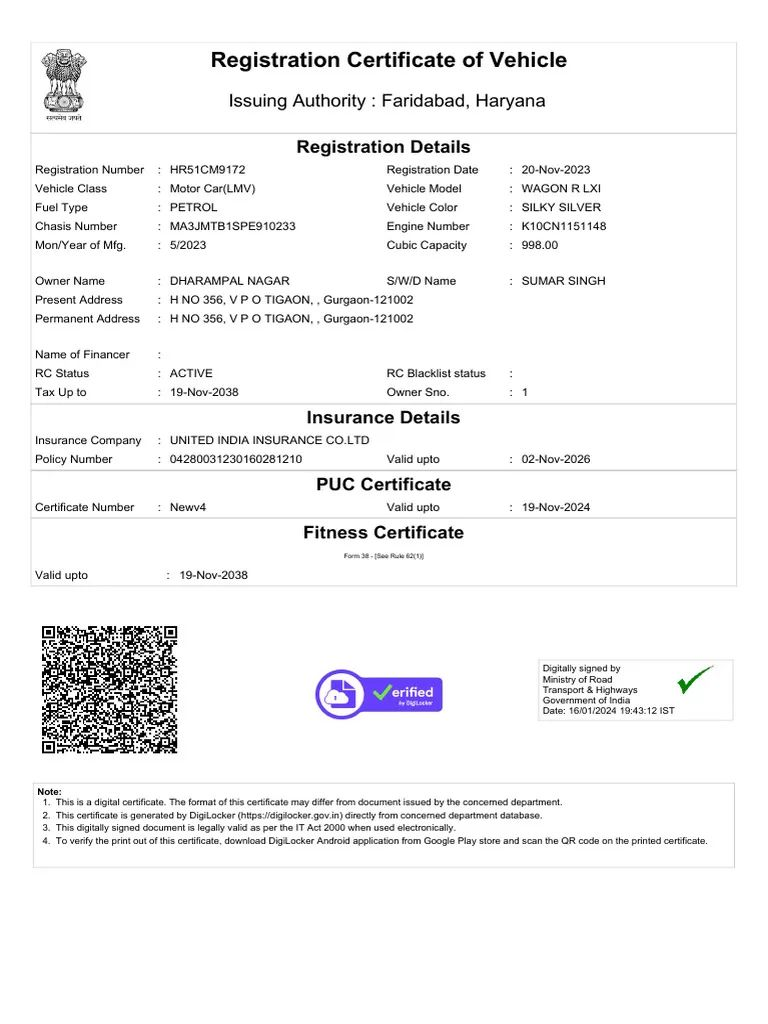
Every motor vehicle registration is issued by a Regional Transport Office, or RTO — the vehicle registration office that governs your area. The RC lists your vehicle’s chassis number, engine number, owner name, fuel type, and class. It’s also the closest thing India has to a US-style vehicle title: there’s no separate vehicle title and registration document here. The RC does both jobs at once.
When Do You Actually Need to Renew?
For private cars and bikes, the first registration cycle runs 15 years from the date of purchase. After that first cycle ends, you renew every 5 years, as long as your vehicle keeps passing its fitness check. Commercial vehicles run on a shorter, separate fitness-certificate cycle set by the RTO, usually reviewed annually or every two years depending on vehicle class.
The rule that trips people up: you can’t wait for the expiry date. You need to file your renew registration application up to 60 days before the current certificate lapses. File late, and you’re already looking at penalty charges the moment it expires.
Documents You Need for Registration Renewal
RTOs across states ask for slightly different paperwork, but these vehicle registration documents cover almost every case. Gather these before you start, and you’ll avoid a second trip
The vehicle registration requirements above cover general private-vehicle renewal. Commercial vehicles usually add a fitness certificate and, for older vehicles, a green tax receipt. Always check your local RTO’s page for state-specific vehicle registration renewal requirements before you go.
How to Renew Vehicle Registration Online
Most states now support online vehicle registration renewal through the Parivahan Sewa portal, though a physical vehicle inspection is still required at the end. Here’s the exact path.
- Open Parivahan Sewa Go to “Online Services,” then “Vehicle Related Services,” and pick your state.
- Select your RTO and “Renewal of Registration” Choose the nearest office and confirm to proceed with your vehicle registration application.
- Enter chassis number and verify Key in the last five digits of your chassis number, then verify your registration details.
- Confirm with OTP An OTP lands on your registered mobile number. Enter it to unlock your record.
- Make your vehicle registration online payment Pay the renewal fee through UPI, net banking, or card. This vehicle registration payment covers the base renewal charge, not the RTO inspection.
- Book your inspection slot Set a vehicle registration appointment at your chosen RTO for the physical check.
- Visit the RTO with your vehicle Carry the printed receipt, your documents, and the vehicle itself. This part of the vehicle registration process can’t be skipped — India has no fully remote renewal path yet.
Once the inspection clears, your renewed RC ships to your registered address, or you collect it directly. Full car registration renewal online processing usually takes 7 to 14 working days after the inspection.
How to Renew Registration Offline, at the RTO
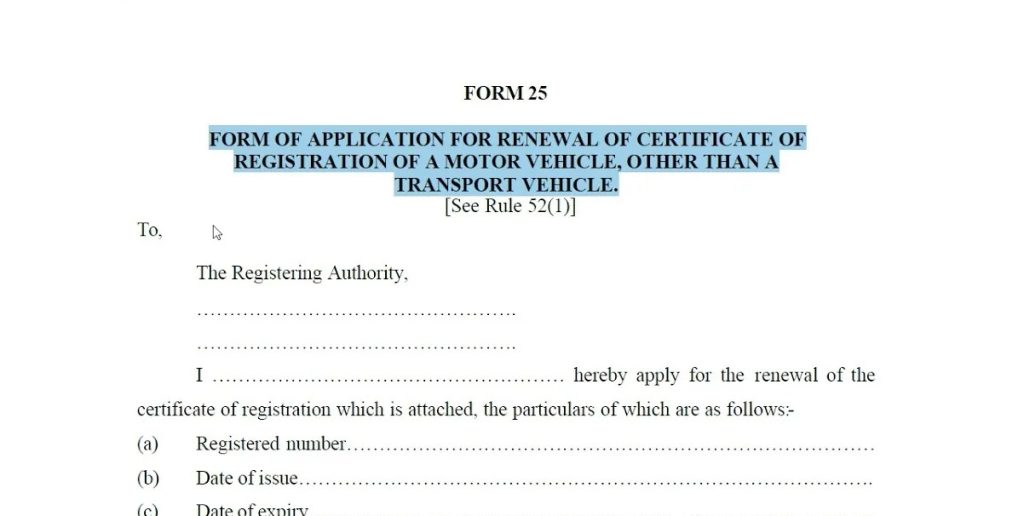
Prefer paper? You can still handle this the old way. Collect Form 25 from the RTO counter, fill it in by hand, and attach the same documents listed above. Pay any pending road tax at the cash counter, then present your vehicle for inspection on the spot.
If you’re not sure where to renew vehicle registration offline, it’s always the RTO where the vehicle was first registered — not just any office near you, unless you’re also filing an address change alongside the renewal.
Vehicle Registration Renewal Fees in 2026
Fees run under Rule 81 of the Central Motor Vehicle Rules, 1989, and they scale with vehicle class. Here’s the current baseline. Always confirm the exact vehicle registration cost with your state RTO, since a few states add small surcharges.
| Vehicle Class | Base Renewal Fee |
|---|---|
| Two-wheeler (motorcycle registration renewal) | ₹300 |
| Private car / light motor vehicle | ₹600 |
| Medium passenger / goods vehicle | ₹1,000 |
| Heavy passenger / goods vehicle | ₹1,500 |
| Smart card reissue | ₹200–300 |
Late renewal adds a penalty on top of the base vehicle registration renewal fees: roughly ₹300 per month for two-wheelers and ₹500 per month for cars, counted from the expiry date. Renew a car three months late, and you’ll pay ₹1,500 in late fees before the base charge is even added.
One clarification worth knowing: GST does not apply to the renewal fee or road tax renewal itself, since these are government charges, not a taxable service. GST at 18% only kicks in if you buy or renew insurance alongside your RC.
If you’re renewing a two-wheeler, note that a straightforward bike registration renewal costs less than a four-wheeler and rarely needs anything beyond the standard checklist above. A basic car license renewal or vehicle license renewal follows the same path, just at a higher fee tier.
The Fitness Test
Every renewal past the first 15-year mark comes with a physical fitness inspection, and it’s more thorough than most owners expect. Inspectors check your brakes, steering response, headlight and indicator function, tyre condition, chassis integrity, and emission output against current pollution norms. Commercial vehicles get an additional structural check on the load body.
A passed fitness certificate is valid for 5 years. If your vehicle fails, you get a list of fixes and a window to repair and reapply — you don’t lose your renewal slot outright, but you do lose time.
Renewing After 15 Years
Once your vehicle crosses 15 years, renewal isn’t automatic anymore. It’s tied entirely to the fitness test. Pass it, and you can keep renewing every 5 years. Fail it with major structural or emission issues, and the RTO can direct the vehicle toward scrapping instead of reissuing an RC.
This is also the point where it’s worth running the numbers rather than assuming renewal is the obvious choice. Add up your likely repair costs, your current insurance premium, and what the car would fetch on resale today. If those numbers are close to what a newer used vehicle would cost you, scrapping under the government’s incentive scheme — which often includes a rebate on your next purchase — can work out better than sinking money into an ageing vehicle.
Delhi-NCR runs on a stricter timeline than the rest of India. Under an NGT order upheld by the Supreme Court, diesel vehicles older than 10 years and petrol vehicles older than 15 years cannot be driven, parked, or re-registered anywhere in the National Capital Region — regardless of your vehicle’s fitness condition. This is separate from, and stricter than, the standard 15-year renewal cycle that applies to the rest of the country.
Delhi-NCR’s Age-Based Deregistration Rule
If you own a car in Delhi, Gurugram, Noida, Faridabad, or Ghaziabad, this section matters more than anything above it. The National Green Tribunal ordered the deregistration of ageing diesel and petrol vehicles specifically in the NCR, and the Delhi Transport Department enforces it year-round, not just during high-pollution months.
Once your diesel vehicle crosses 10 years, or your petrol vehicle crosses 15 years, it’s automatically ineligible to keep running in NCR, no matter how well it passes a fitness test elsewhere. Your two real options: apply for a No Objection Certificate and re-register the vehicle in a state outside the NCR, or surrender it for scrapping. A vehicle re-registered outside NCR under this rule can’t legally return to Delhi roads afterward — it stays tied to its new state.
Moving States: Ownership Transfer and Re-Registration
Relocating permanently, or keeping a vehicle in a new state for over a year, triggers a separate process from routine renewal: vehicle registration transfer. You’ll need a No Objection Certificate from your original RTO, and if the vehicle is financed, your lender’s hypothecation clearance too.
The vehicle ownership transfer process also covers a fresh number plate renewal, since your registration number changes to match the new state’s coding. If you’ve heard of “license plate renewal” in a US context, this is India’s closest equivalent — except here it’s tied to the state-specific registration mark, not a yearly sticker.
One shortcut worth knowing: if you’re a government employee, defence personnel, or work for a company with offices in four or more states, you likely qualify for a BH-series (Bharat series) plate. It follows you across state moves without repeated re-registration — a real time-saver if you transfer cities often.
Checking Vehicle Registration Status, Details, and History Online
Before you buy a used vehicle, or just to track your own renewal, Parivahan’s VAHAN portal gives you a fast rc status check. Enter the registration number, and you’ll pull up the vehicle registration details on file: owner name, registration date, vehicle class, insurance validity, and fitness expiry.
This same tool works for a broader vehicle registration search, a vehicle registration lookup on any Indian-registered vehicle, or a simple vehicle registration check before a purchase. If you’re only tracking an application you already filed, the “Application Status” section shows real-time progress using your reference number.
Looking for vehicle registration renewal near me? The same VAHAN portal lets you filter by state and city to find your nearest RTO, along with its working hours and inspection slots.
Downloading Your RC as a PDF
You don’t need to carry the physical smart card everywhere anymore. Through DigiLocker or the mParivahan app, you can pull a rc download pdf copy that’s legally valid to show traffic police, on par with the physical card. Log in with your Aadhaar-linked mobile number, search “Registration of Vehicle,” and enter your registration and chassis numbers to fetch the document instantly.
These vehicle registration services extend to duplicate RC requests too, in case your smart card gets lost or damaged — no need to wait for a fresh physical copy before you’re back on the road legally.
RC Verification
Buying a used vehicle without checking the paperwork is one of the most common ways people get scammed in India. Run a quick rc verification through Parivahan’s “Know Your Vehicle Details” tool before you hand over any money. Match the chassis number, engine number, and owner name against the physical RC in front of you.
This vehicle registration verification step takes under two minutes and can save you from inheriting someone else’s unpaid challans, hypothecation, or a stolen vehicle altogether.
What Happens If Your Renewal Application Gets Rejected?
Rejections usually come down to three things: a document mismatch, an unpaid challan sitting on your record, or a failed fitness inspection. The RTO vehicle information will tell you exactly which one applies. Fix the specific issue, whether that’s clearing a pending fine or repairing a flagged fitness item, and you can typically reapply within about a week without starting the entire process from zero.
The Real Cost of Ignoring Renewal
Driving with an expired RC isn’t a paperwork technicality; it carries real penalties under Section 192 of the Motor Vehicles Act, and in serious cases, your vehicle can be impounded on the spot. Your insurer can also reject a claim outright if your registration had already lapsed at the time of an accident, leaving you to cover repair or liability costs entirely out of pocket.
One quick note if you’ve been searching using US terms: India has no dmv vehicle registration renewal office. The RTO is India’s equivalent of the DMV, and it’s the only authority that handles this process here.
Other RTO Services You’ll Likely Need Too
Since you’re already dealing with the RTO, a few related services are worth bookmarking. If you’re planning to drive abroad, you’ll need an international driving permit, issued separately from your regular licence and valid only alongside it. If you’re waiting on a new or renewed licence, you can track your dl application status on the same Parivahan Sakshi portal used for vehicle services. And if your licence card is lost or damaged, applying for a duplicate driving licence follows a similarly quick online process.
Frequently Asked Questions
Can I complete the entire renewal online without visiting the RTO?
No. You can submit documents and pay fees online, but a physical vehicle inspection at the RTO is still mandatory before your RC gets renewed.
How many days before expiry should I apply?
Apply up to 60 days before your current registration expires. This gives the RTO enough time to schedule your inspection before the deadline.
What’s the penalty for renewing late?
Roughly ₹300 per month for two-wheelers and ₹500 per month for cars, calculated from your expiry date, on top of the standard renewal fee.
Is the process different for commercial vehicles?
Yes. Commercial vehicles follow a shorter fitness-certificate cycle and typically need additional documents, including a valid fitness certificate and permit records.
Can I renew my RC if I’ve moved to a different state?
You’ll need a fresh registration in the new state instead of a simple renewal, along with an NOC from your original RTO and hypothecation clearance if the vehicle is financed.
Is GST charged on RC renewal fees?
No. GST doesn’t apply to the base renewal fee or road tax. It only applies to any insurance premium you buy or renew alongside your RC.
How long does online renewal actually take?
Once your inspection is cleared, expect 7 to 14 working days for the renewed RC to process and reach you.
Does the Delhi-NCR age ban apply even if my car passes the fitness test?
Yes. The NGT’s age-based rule overrides fitness results in NCR. A diesel vehicle past 10 years or a petrol vehicle past 15 years is ineligible to keep running there regardless of condition.
Key Takeaways
- File your renewal up to 60 days before expiry, not on the day it lapses.
- Keep insurance, PUC, and road tax current — renewal gets rejected without them.
- A physical RTO inspection is unavoidable, online or offline.
- Delhi-NCR owners face a stricter age-based rule that can override a passed fitness test.
- Verify any used vehicle’s RC before you buy — it takes two minutes and prevents real financial risk.